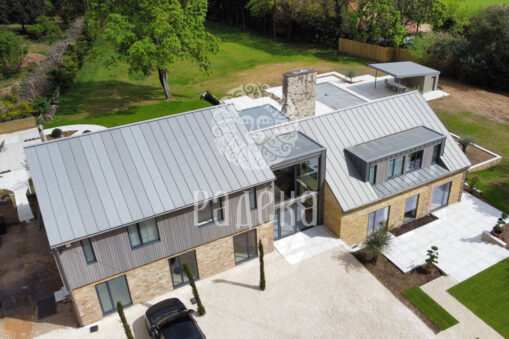
Zinc-titanium is an excellent roofing and facade material having a long service life and perfectly adaptable to mechanical processing. The main application of sheet zinc-titanium is tiling or folding coverings for finishing roofs and facades of the houses.
Zinc-titanium history
Using zinc in construction lies deep. And in the end of 1960s one managed to improve qualities of the metal by cleaning it from impurities and compounding a complex of admixtures from titanium, copper and aluminum. An alloy became more ductile, increased its anticorrosion features two times and a service period up to 100 years.
The history showed that zinc is a perfect roof covering often equal in its characteristics to copper. Corrosion rate of pure zinc in the atmosphere is 5-10 mcm per year.
Advantages of zinc-titanium
• Low weight. 5,04 kg per sq.m at 0,7 mm zinc-titanium tape;
• Ductility. This quality allows shaping any folding covering and realize any architect’s ideas;
• Longevity. Estimated service life of zinc-titanium roof is 100 years at 0,7 mm metal thick;
• Assortment. Availability of all necessary accessories, drains, snow retention and décor elements of zinc-titanium;
• Maintainability and tooling quality. Possibility to repair the elements of a roof covering with the help of soldering;
• Corrosion resistance. The most important quality of zinc-titanium not requiring confirmation.
Standing seam roof made from light-weighted zinc-titanium is extremely ductile. This quality allows applying it in the most interesting and complicated architectural designs. At the same time zinc-titanium is not absolutely apt to corrosion and has a noble discreet brilliance inherent only to it.
Zinc-titanium manufacturers
Rheinzink. German zinc-titanium Rheinzink meets high ecology requirements and has perfect aesthetic qualities and a high level of longevity. It was the company Rheinzink founded in 1966 in Germany that first replaced a traditional manufacturing of zinc with an innovative one.
NedZinc. Netherlandish company was founded in 1892. Since then the company had got over several mergers and now NedZinc is one of the largest European manufacturers of zinc-titanium for construction industry.
VM Zinc. Production of the French company is a high-qualilty zinc-titanium for roofs and facades installation. Innovative technologies and a modern equipment allow to release products having the highest operational characteristics.
ElZinc. Spanish corporation Asturiana de Laminados under the trademark ElZinc manufactures and delivers premium roof and facade zinc-titanium of a wide color and coverings range.
Kinds of patinated surfaces of zinc-titanium
The main differences of zinc-titanium from different manufacturers include nuances of material processing for giving it one color or another. Due to its ability to generate a protective oxide membrane roofs and facades of zinc-titanium have a long service period. Formation of patina begins just after the first contact with environment. Zinc is patinated during the whole service period but is getting dark negligibly slowly. After finishing of the patination process the surface of zinc-titanium is getting a smooth gray color.
Colors of zinc-titanium
Natural shades of zinc vary from light-gray to dark-gray according to the amount of alloying additives. Any another color including dark-gray is the result of artificial patination. As rule manufacturers offer zinc-titanium of several kinds – an ordinary one and one or two variants with patinated surface. Also in the market there is zinc-titanium having an artificially formed patina layer with additional inclusion of mineral pigments of blue, red and green colors.
Particular features of zinc-titanium roofs and facades installation
- The process of zinc-titanium roofs and facades installation has a number of significant features depending on the material’s qualities. To get a truly high quality and guaranteed durable roofing one should entrust installation to specialists of appropriate qualification and experience.
- Classic method of zinc-titanium installation is an arranging of folding covering of the roof and facade. A formed folding facade or a roof looks concisely and aesthetically and also avoids the possibility of leakages. High ductility of zinc-titanium allows producing details of complex shapes.
- While installation of roofs and facades one must use only special tool designed for xinc-titanium processing.
- All installation works are carried out according to thermal dilatation of metals (zinc-titanium has got a large coefficient of linear dilatation – 2 mm per 10 m at temperature gradient of 100 degrees). When installing folding pictures in most cases it is necessary to apply sliding cleats. A compensation gap (up to 3 mm) between adjacent seam panels is required.
- It’s prohibited to install the roof or facade of zinc-titanium at air temperatures lower than +5˚C. When installing of seam panel-pictures in cold weather it’s necessary to heat processed areas.
- The roofing pie must contain high-quality vapor barriers. And the system of under-roof ventilation must be well-though-out.
- Properly designed and executed without technology deviation zinc-titanium roofs and facades will serve not less than 100 years.