Marble is a widespread rock. It’s typical of marble to have grainy structure, content of calcite, slight hardness, smooth grains’ surfaces and a reaction to diluted hydrochloric acid. Marble doesn’t leave scratches on glass. It can be confused with harder rocks such as quartzite and jasper. The difference is that quartzite and jasper don’t react to diluted hydrochloric acid.
Marble which origin is connected mainly to the formation of calcite in its structure was named for calcite marble; but if there’s mostly dolomite it’s common to speak of a dolomitic kind of stone. As for the origin of the word “marble”, the Greeks some day were amazed by its shine and beauty so much that they named it μάρμαρος – that means “shiny stone”.
Physical characteristics of marble
Density 1900 to 2900 kg/m3
Porosity – max 1%
Mohs hardness level – 3 to 4
Water absorption – 0,15-0,6%
Fracture resistance index – 10-3 mPa
Compression – 100 to 250 mPa
Specific gravity – 2,7 g/cm3
Natural marble includes such minerals like chalcedony, feldspar, hematite, quartz which are formed in different ratios to each other. The number of such impurities in it directly influence on marble’s characteristics as appearance, hardness, structure peculiarities and the area of use.
Advantages of natural marble
• Strength and ductility. Stone is easily processed, doesn’t crumble or break to pieces, is not damaged while polishing or drilling holes in it.
• Eco-friendliness. Marble doesn’t absorb radiation and absolutely safe for ecology because it doesn’t emit any harmful chemicals.
• Low water absorption. It’s perfect for cladding interior spaces with high level of humidity – water closets, bathrooms, hammams etc. It’s resistant to temperature differences.
• Longevity. If marble is taken good care of it won’t turn yellow or change its original appearance.
Furthermore, natural marble has got constant air circulation in its structure without accumulating harmful micro-organisms. The air in the room will always be clean and fresh and a microclimate is going to be favorable for human health.
Using marble in construction and decoration
Mainly marble is used for interior decoration as well as for exterior facing of buildings in the regions with rather mild climate.
Specifics of using marble for decoration
• Abrasion. It’s not recommended to use marble where there is high permeability: the surface will be quickly trampled and have unsightly appearance.
• Reaction to acids. Where marble is used there mustn’t be any kinds of acids and cleaning chemicals.
• Color variations. Marble’s color varies so if it’s planned to decorate large scales it will be difficult to match the same shade.
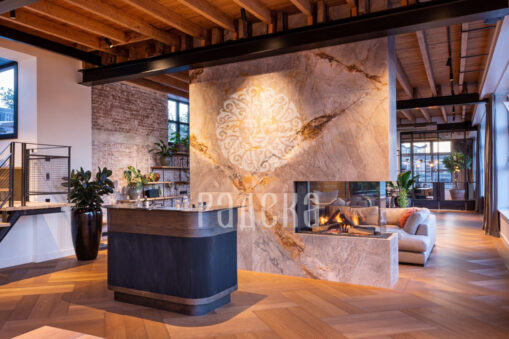
Also marble stone is used for creating mosaic compositions, decorating hamams and spa areas, for facing fireplaces, barbecue areas, fountains, for making countertops, stairs, floor, window sills, flowerpots and balusters.
Color range of marble stone
White marble is truly unique. It is this kind which represents the main material for creating majestic sculptures and bizarre statuettes. Among white stone you can meet examples with thin colorful veins which give it a special charm and originality.
Black marble is extremely rare version that was originated in the result of volcanic activity. There can often be admixtures of graphite or bitumen. Sometimes one can find this colored stone with golden specks and veins that makes it especially precious.
Green marble is produced when it contains iron-bearing silicates. It is them that give it rich green color but flecks and veins can be both brown and white. The pattern can look like branches or waves.
Red marble is rather unusual; its color depends on the presence of iron oxide in structure. The use of red marble in construction is closely connected with the construction of ancient temples and palace buildings. In modern time it’s used for decoration of the premises intended for large public celebrations.
Grey marble can have either coarse-grained or fine-grained texture. Its color shades can be rather various with rare or regular veins of dark-yellow, pink and white colors. One can find also dark-grey marble which is especially resistant to the impact of harmful substances.
Beige marble can be of cream shade, coffee and deep dark color. Patterns and flecks on its surface have an especially bizarre shape that occurs due to limonite and manganese admixtures. Durability of this material is very high so beige stone is often used for floor works.
Pink marble like its red variations has iron-containing admixtures which give it a soft pink color interspersed with dark-green veins giving it special beauty.
Blue kinds of marble are presented mixed with grey and white colors. The blue color itself is caused by diopside and what color this kind of marble will be directly depends on the amount of diopside in its structure. If there’s much of it the shade will be deep and even dark-blue.
Yellow marble unites all the shades of yellow which also exist in the natural palette of the stone. Shades of golden and beige color in addition to the main create amazing stains. Window sills, tables and countertops and also decoration elements are produced from yellow stone.
Marble quarries
The largest marble quarry in Russia is the Kibik-Kordon quarry (Krasnoyarsk Territory) where is mined about twenty kinds of marble of different colors from white to greenish-grey. There are large marble quarries in the Urals – Aidyrlinsky and Koelga quarries of white marble situated in Orenburg and Chelyabinsk regions respectively.
Black marble is mined at the Pershinsky quarry as well as yellow at the Oktyabrsky quarry and lilac at the Gramatushinsky quarry in Sverdlovsk region. Marble from Karelia (near Tivdia village) of soft fawn color with pink veins was firstly used for the decoration in Russia; it was applied in the interior decoration of St. Isaac’s Cathedral and Kazan Cathedral in Saint Petersburg.
Stone is met at Baikal (reddish-pink stone from Burovshchina), in Altai (Orokotoy quarry), in the Russian Far East (green marble). Also it’s mined in Armenia, Georgia (red marble from New Shrosha), Uzbekistan (Gazgan quarry of cream and black stone), Azerbaijan, Tajikistan, Kyrgyzstan and Greece (Paros island).
Sculptural marble which is well suited for processing is mined in Italy (Karrara). World-famous sculptures “David”, “Pieta”, “Moses” by Michelangelo Buonarroti were made from the same Italian marble from Karrara quarry. White stone mined in Toscana on Italian lands remains precious to this very day and products from Toscana marble are rather demanded among collectors.
Marble which kinds are plentifully widespread in different corners of our planet for centuries has been the most beautiful and demanded material for creating real masterpieces of construction and sculpture. Shine and timeless beauty of marble products is going to remain demanded by the humanity forever and ever thanks to their longevity and elegant beauty.