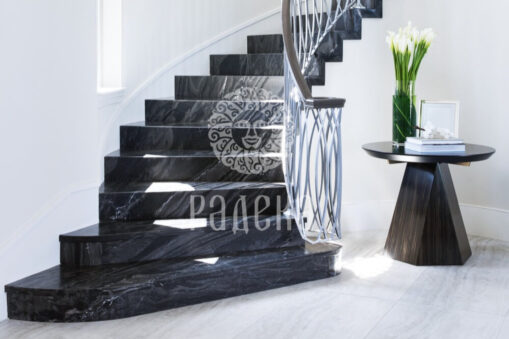
Stairs of natural stone is one of the main and necessary constructive elements of the house; the element which is an integral architectural part not only of interior but also facade of any building. Steps of natural stone are customary to form stairs in private houses, cottages where there is a necessity and a wish to underline taste and status of the owner. The view of natural stone evokes a sense of exclusivity; stairs of natural stone falls to the place in almost any architectural style.
Advantages and disadvantages of stone stairs
Stairs suppose a regular mechanical load during walking regardless of the size and structure therefore one should choose a finishing material basing on their operational purpose. Stone stairs have a number of positive and negative sides. All of them depend on technological characteristics of the stone itself.
Advantages:
• Durability and reliability of stone stairs. Rocks of natural stone that we work with are dense and solid structures which are resistant to abrasion and mechanical hits. As a result such stairs may be used during many years performing just minimal restoration works for grinding and polishing of the stone surface of steps and other elements of stairs;
• An exquisite appearance allows placing the right accents in classic interiors. As a complementary touch one may install accent lighting;
• Practicality of stone stairs. Due to smooth glossy surface of natural stone it’s incredibly easy to look after. To wipe a surface of stone steps with a damp cloth is enough and hygiene is provided. By the way it’s important to note a water resistance of natural stone which allows applying any kind of cleaning stairs like wet cleaning among others;
• A wide color range of natural and artificial stones so it’s not worth worrying about matching diverse décors;
• Ecological compatibility. Representing a natural material stone doesn’t emit toxic fumes ensuring safety of inhabitants of the room and doesn’t have an unpleasant smell;
• A wide range of colors and textures of stone.
Disadvantsges:
• High price for the products of natural stone. If you want to apply stone but the budget doesn’t afford using expensive natural materials then using steps of artificial stone for finishing stairs is a worthy decision;
• Heat absorption. Natural materials do not have high heat transfer and stone on the contrary just absorbs received heat but at the same time its surface doesn’t warm up. To neutralize such a disadvantage one can lay a carpet strip on steps;
• A considerable weight of stone structures. You should think of it at the initial stages of the house construction in order to calculate the load on the foundation. If a building has already been constructed then it’s advisable to do a partial facing with stone. That is wood can be a base where stone tablets will be laid.
Manufacturing and installation of stairs of natural stone is a difficult painstaking work that only qualified and experienced specialists can do.
Optimal size of stairs:
• Canting angle up to 35 degrees allows building safe stairs;
• Optimal step depth – 250-300 mm;
• Optimal step height is 150-180 mm;
• Recommended height between ceiling and steps must be not less than 1900 mm;
• Safe height for handrails is 900 mm.
Size of stone stairs is necessary to plan earlier before construction starts. It’s necessary to calculate free space and a load on the foundation.
Natural stone for stairs
Well-chosen material is able to turn ordinary stairs to the second floor of your house or cottage to a work of art. What characteristics do natural slabs have and what stone should you choose?
Granite. A solid stone of magmatic origin, reliable and strong. The material holds water and has an original natural pattern. All this makes granite popular while finishing works in construction. Stairs of granite is a symbol of stability and respectability of your house. It’s perfect for applying in the exterior of the building – balcony, porch, entrance group.
Marble. A metamorphic rock consists of calcite and admixtures. Coloring of marble is defined by the admixtures compound. Stone pattern can be changed having chosen necessary direction of sawing of work piece. The final color and pattern of this amazing natural material make themselves known after polishing. Marble is less solid and more water absorbing than granite and requires care. Stairs of marble can become a unique creation with the shade of a magic fairy-tale. It will change an interior of the house for lightness and airiness. Marble is easy to process. Supporting pillars and balusters of any shapes for stairs and balustrade are made of it.
Onyx. The mineral refers to semiprecious stones. The cost of finishing with onyx is high but it gives your interior a unique style. The stone differs with its translucency and beauty generously presented by nature. The ability of onyx to transmit light gives unlimited possibilities to get a unique example with the help of various backlights. Onyx keeps warmth and has good physical qualities. Stairs of onyx will bring you comfort and give natural warmth.
Travertine. Aesthetic, functional and economical. It stands out with its abrasion resistance, lightness and a good transcalency. The last quality allows combining it with the heating effectively. It’s sensitive to some chemicals so it requires gentle detergents. Natural shades of light-gray and light-beige colors are perfect for manufacturing stairs and decorated elements.
Steps of natural stone
The most operated elements of any stairs are steps. These are steps that are exposed to the major mechanical loads. That’s why only natural stone – marble and granite, especially if we speak about entrance groups, is the most appropriate material for making steps. Steps of natural stone have a high durability, noble appearance and non-repeatability of texture. Even with high walking transit stairs and steps of natural stone can save an almost original appearance for a long time without extra expenses for restoration and renovation.