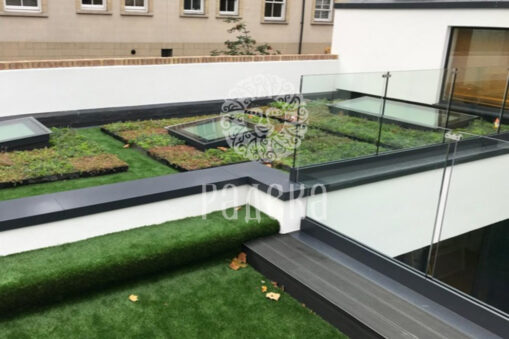
There is a flat roof in construction of 80 percent of industrial buildings and office centers. Such construction is economically favorable when constructing the building since in fact this is a standard enclosing ceiling with heat-protective and waterproofing coating. Modern architecture with its cubical shapes for megalopolis and towns most closely corresponds to flat roofing application.
Flat roofing – inversion or classic?
Flat roofing is one of the most widespread options for roofing application both of residential and industrial buildings. Kinds of flat roofs can be divided into single groups:
Classic flat roof is a construction where the heat-protective coating is under the waterproofing layer. This is the only solution when heat-protective materials absorbing water can be used.
Inversion flat roof is a construction where the heat-protective coating is over the waterproofing layer and defends it from temperature differences and ultra-violet radiation. When applying inversion flat roof the heat-protective coating with zero moisture absorption is used.
Classic flat roof
The idea of a classic flat roof came into the world in the middle of 20th century when bitumen suitable for waterproofing works on the roofs started to be manufactured in industrial volumes. It significantly simplified builders’ tasks that now don’t have to assemble rafter sloping constructions. As the heat-protective coating was used bloating clay, vermiculite, rigid glass wool, foam plastic etc.
Flat roof compound became classic for decades:
Load-carrying structures – slab roof;
Vapor seal covering from glassine;
Heat protection from bloating clay with slope to the spillways;
Leveling sand-cement screed;
Roof covering of 3-4 layers of asphalt sheet on hot bitumen.
Flat roofing pie
Such a pie had to be repaired every 203 years but with the development of technologies asphalt sheet, bitumen, bloating clay and glassine has been replaced by modern materials for flat roofing application that extended its lifetime service several times.
Inversion roof
Inversion flat roof is an invention of the end of 20th century. It couldn’t appear before because manufacturing of the materials included in the construction of inversion roof became possible only at the certain stage of chemical technologies development. Inversion means “converse”. Here usual roofing pie is “turned upside down”: the main roof covering laid straight over the basis is found under the heat protection. Such a scheme is often used for the flat roofing application.
Pros of inversion roof: inversion roof is originally deprived of many problems of traditional scheme. The waterproofing layer covered with the heat protection up has been operated all year round at plus temperature and defended from destroying effects of ultra-violet radiation and mechanical damages. Longevity of the material in such conditions increases many times.
Cons of inversion roof. Because of the difficulty to reach a waterproofing layer for repair and diagnosis (need to remove all the layers) one has to use high effective and expensive materials and also invite high-qualified specialists.
Inversion roof compound:
Gravel as ballast;
Drain layer;
Heat protection;
Waterproofing coating laid on the basis
Inversion roofing pie
Heat protection. It has special requirements. For the inversion system you need such heat protection which won’t decompose, swell or shrink when regular contacting water and also don’t reduce thermal insulation properties and have enough solidity. Extruded polystyrene foam that is usually chosen for the inversion roofs fits the bill. This heat protection is manufactured in our country under several trademarks: Penoplax, Technoplax, Termit 35 etc.
Drain layer. Its purpose is a free transmitting rain water and its filtration from sand and other small particles. As a bonus it defends heat protective layer from damage. As a drain layer they usually use special non-woven sheet from polyester fibers (geotextile) or polyethylene drain membrane representing a coating with pimpled surface.
Ballast. The purpose of ballast is to fix the whole system while wind blowing and prevent the heat protection from floating when flooding the roof after heavy rain. As ballast they use gravel of fraction 20-40 mm. Minimal gravel layer is 50 mm. Maximal roofing slope with gravel mustn’t exceed 5%.
Flat roofing application. Price.
Below there are approximate figures for advance estimate of new flat classic or inversion roofing application. The final cost is defined by complete budget after accounting all the influencing factors.
Traditional roof (vapor seal covering, mineral wool insulation 150 mm, screed, 2 layers of surfaced material) – 2700-3000 rub/sq.m;
Inversion roof (membrane PVC or TPO, extruded FPS (foam polystyrene) 150 mm, geotextile, gravel layer) 2800-3200 rub/sq.m.
Most foreign investors choose inversion option. They see its economical efficiency in rather long periods of time because this technical solution has been used since long ago in industrialized countries.
We are able to assemble the roof of inversion or classic type with the use of the most progressive and resulting technologies and guarantee its sure service for many years.