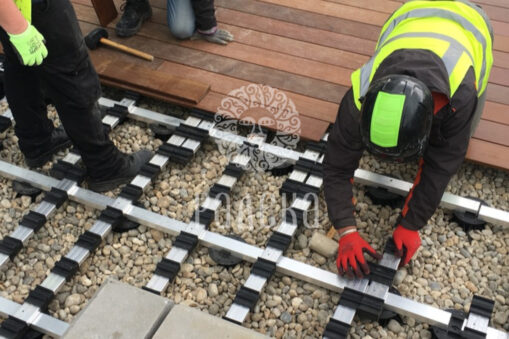
The function of operated roof is the possibility of its using for different purposes without the risk of mechanical damage. The structures of operated roofs are varied but the main feature remains unchangeable – it’s a possibility of using flat roof all the year round without fear of damage.
Almost every flat roof can be turned to a platform for pedestrians. We carry out all the needed works for a turn-key application or repair of operated roofs with a documentary guarantee. Before carrying out installation works we try to estimate future loads on heat protection and waterproofing.
The cost of an operated roof application
In the table below there are approximate figures for advance estimate of expenses for application or repair of operated flat roofs and terraces. The final cost is defined by complete budget after accounting all the influencing factors which can increase or decrease price.
Description unit up to 20 sq.m 20-100 sq.m from 100 sq.m
Application of rolled or self-leveling waterproofing sq.m from 1,500 from 1,300 from 1,100
Abutments application long m from 1,300 from 1,100 from 900
Installation of decking floor with a frame on racks sq.m from 2,400 from 2,200 from 1,900
Installation of tiling floor on a gravel pad sq.m from 1,600 from 1,500 from 1,300
Minimal cost 190,000 rub
The price of an operated roof depends on:
• The type and thickness of waterproofing
• Material for finishing covering
• Area of works
The course of a classic structured operated flat roof application
Today operated roofs are widely demanded for organizing sports grounds, green zones, cafés, parking areas and so on. The installation of such a roof is also needed if it’s supposed to place some equipment.
1. Firstly the formation of roof surface slopes is executed in order to create directions of water runoff. Basement with slopes can be made from bloating clay, foam concrete, sand-cement screed and prefabricated asbestos cement slabs;
2. Then water intake funnels suitable for an operated roof are installed. They differ from ordinary ones with reinforced grid for protection from impurities;
3. Vapor barrier and heat protection layers of calculated thickness and density are placed. Density and rigidity of heat protection play a key role while an operated roof application. By no means it must undergo deformation under loads;
4. According to the type of a waterproofing cover an intermediate carrier layer is laid out. It can be armed sand-cement or dry prefabricated screed. In some cases polyethylene or geotextile layer is sufficient;
5. Waterproofing type for an operated flat roof is chosen within budget. But don’t forget that requirements to waterproofing on such roof are increased. It will be hidden under the finishing flooring and there will be no possibilities to the regular maintenance.
For example the lifetime service of polymer-bituminous Technoelast is 20-25 years. Imported and Russian PVC membranes – 30-40 years. German Resitrix – 50-70 years. But these terms will be relevant due to high-quality laying and welding in compliance with the technical requirements of manufacturers.
The tiling or decking with a frame on racks can serve as a finishing flooring of a flat roof. Often a flooring of porcelain tile is laid on the cement screed by adhesive layer. But thanks to Russian temperature and humidity differences such a covering lasts not more than 2-3 years.
The course of an inversion structured operated flat roof application
In case of inversion roof a waterproofing barrier is under a heat protection barrier. It extends the lifetime service of waterproofing but at the same time makes it difficult to find and repair the places of accidental leaks. Otherwise both types are quite similar.
1. The formation of roof surface slopes is executed in order to create directions of water runoff. Basement with slopes can be made from bloating clay, foam concrete, sand-cement screed and prefabricated asbestos cement slabs;
2. Waterproofing covering of increased degree of reliability is laid. Nowadays membranes PVC and EPDM have proven themselves well. In case of professional installation such coverings serve on operated roofs for 20-50 years;
3. There are special requirements to the heat protection of inversion roof. It must be a material that as absolutely resistant to water. Extruded foam polystyrene (XPS), polyisocyanurate (PIR), polyurethane foam (PU foam). There are layers of draining mats and geotextile materials which filter and direct water over and under the heat protection;
4. Inversion roofs need to be used with surcharge weights. Gravel filling that you can lay the path of heavy paving slabs on is well suited for this.
In modern cities more and more often you can see the houses with flat roofing where is an open café working or a recreation zone with a swimming pool, a car parking or a helipad.
Specialists of the company “Radeka” have all the needed qualification and a considerable practical experience that allows us to carry out works on application and repair of flat roofs. If you are interested in a high-quality work, please contact us, we will be glad to help you.