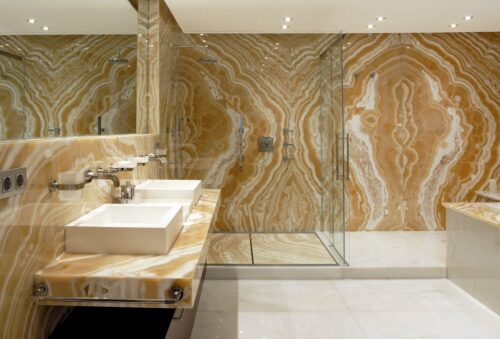
The use of decorative stone in interiors never goes unnoticed. This material brings a particle of living nature into the room, reminds us of the value of everything simple and natural. In addition, a stone is a material that is both externally and inherent in its properties – strong, strong, massive and very colorful. His presence is somewhat obligatory, when selecting furniture and decorations, you must always take into account the fact that the room already has a natural stone, its structure, scale, covered surface and color scale.
There are two types of decorative stone: natural and artificial. Natural stone is most often supplied in large and heavy slabs, from which in the future the necessary elements and shapes are cut out. Most popular: marble, onyx, granite, labradorite, sandstone, limestone.
Artificial is an imitation of the appearance of natural stones, most often there is a design for brickwork, shell rock, limestone, river stone, jasper, slate, basalt and travertine. Artificial stone is made both in the form of layers, and more convenient formats – rectangular and thin sheets of length and width not more than 1 meter.
Let’s look at some examples on what surfaces you can use decorative stone in the present time, so that it looks not only natural, but also stylish.
Wall cladding around the perimeter
In this case, it is preferable to use calm colors without a pronounced texture. As you can see in the photo below, this presentation can look very elegant and restrained, contrary to the established opinion about the “brutality” of all types of stone decoration. The size of the elements should be chosen based on the total area and height of the walls – the larger they are, the larger the size of the slab you can afford to use without violating the balance of proportions.
Decoration of doorways and portals
Excellent solution for openings in which door leaves will not be mounted. Leave them simply plastered – not too practical (over time, the edges are rubbed and do not look neat). The traditional solution can be called the design of the portal wooden box and clypeus.
For those who are not afraid of experiments – to help come decorative stone. It immediately allocates a beautiful and wide opening, to which you would like to draw everyone’s attention. In addition, it is not difficult to clean a decorative stone – this can be done with a sponge, a brush and special tools, so do not be afraid of contamination and wear.
Identification of architectural features
In the event that, according to the architect’s idea or due to the necessary alterations in the room, a protruding wall or other area appears that requires a special approach, use a decorative stone for its facing.
Facing of premises with high humidity
For the sake of justice, this item is relevant only for natural stones. They are resistant to the interaction with water, so you can safely wall them with shower walls or even the entire bathroom or spa area. In combination with a rain shower, white towels, candles and live plants, you can create the atmosphere of a real expensive resort with a wellness area, which you can spoil yourself daily.
Decorative stone is a universal material. It is good for a variety of colors and shapes, so in almost any environment it can be appropriate if you choose the right one for these two characteristics. Do not be afraid of the stone, use it in living quarters, with only one look-it’s better less than more. All the same, this material is rather rough, and the best solution is to allocate a certain area for them, rather than covering all surfaces indiscriminately.