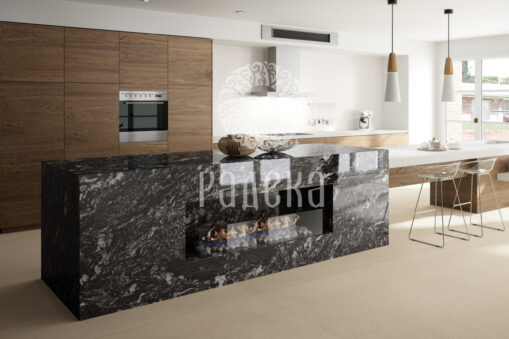
Granite is an igneous intrusive polymineral rock of acid composition most commonly found in the earth’s crust. Granite contains various elements responsible for color, structure, durability and many other characteristics. Mostly granite consists of feldspar, quartz and mica.
The properties of granite have been examined long ago; it was widely used in construction and is also used nowadays. A huge amount of granite structures and ancient monuments have survived to this day. The unique composition of this wonderful stone, its beautiful grainy texture and useful properties make granite irreplaceable building material.
Advantages of natural granite
Advantages of granite still allow us to admire architectural constructions made from it in ancient times.
• Longevity. Fine-grained kinds of granite show the first signs of abrasion only after 500 years. That’s why it’s called an eternal stone.
• Durability. Granite is considered to be the second most durable stone after diamond because it’s resistant to compression and abrasion. This is due to properties of quartz which is part of granite and also high density of the stone that is almost three tons per cubic meter.
• Water resistance. Because of this characteristic granite is so cold-proof. So it’s perfect for embankment facing.
• Weather resistance. Granite can withstand temperatures from minus 60 degrees up to 50 degrees Celsius. It’s rather important in cold climates. Research has proven that granite products don’t lose their properties after even 300 times of freezing and thawing.
• Ecological purity. Granite is absolutely nonradioactive and therefore safe for any civil works.
• Fire resistance. This rock begins to melt at 700-800 degrees Celsius. So using granite in construction and exterior decoration of the building is not only beautiful, it’s also safe.
• Ease of processing, compatibility with any building materials, variety of textures and colors make it irreplaceable material for interior design.
• Resistance to acids and fungi.
Using granite in construction and decoration
Granite is actively used as a building and facing material. Unlike metal, granite is resistant to acids and salts, is not afraid of water. It’s used for making blocks, plates, cornices, curbs, millstones and rollers for mills, parts of different machines and units for pulp and paper, food, machine tool, metal and porcelain-faience industries.
Granite tiles are material for manufacturing the bases of precision instruments. Granite rubble is an essential material for manufacturing of reinforced concrete products and structures. Granite blocks are for decoration buildings. They make monuments, countertops, stairs, floors and paving stone from granite. This is because fine-grained kinds of granite begin to crumble only after 500 years. It’s resistant to various influences and rather durable.
Properties of granite allow people to use it widely in construction:
1. Most monuments and memorials are made from it.
2. Its durability and resistance to abrasion let us use stone for making stairs, flooring, facing entryways and even pavements.
3. In cold climates the most demanded building material is granite. Its properties allow facing buildings and even embankments in such areas where can be rather severe winters.
4. This stone is able to transform your house both inside and outside. Designers successfully use it for making pillars, stairs, baseboards, countertops and handrails. Also it’s used for facing houses’ facades.
5. Using granite in swimming pools, bathrooms and fountains is possible because it doesn’t pass water. And also it doesn’t crumble after it.