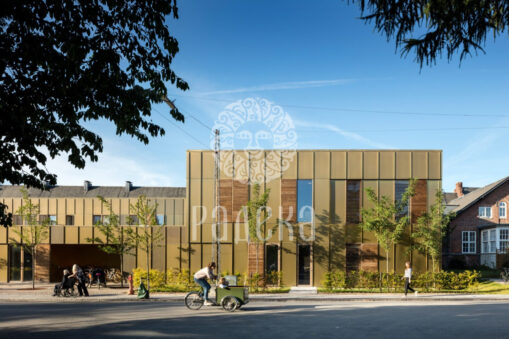
Nowadays copper facades are very popular in private housing construction and civil architecture. If you can’t usually see a copper roof from the ground then the facade is a face of the house; it’s impossible to miss it. Facade cladding with copper is always interesting and up-to-date design solution.
Advantages of copper facades
• Resistance to corrosion. The thicker patina layer covering copper is the more resistant to the atmospheric phenomena it becomes.
• Longevity. Thanks to the natural protection the lifetime of copper facades is up to 700-1000 years.
• Resistance to temperature differences. Temperature differences have almost no effect on the geometry of copper elements: expansion of this metal when heated is up to 40% less than of zinc and lead.
• Easy care. Copper facades don’t need to be washed or processed in any way.
• Lightweight. Compared with ceramic, copper facade is three times lighter.
• Electromagnetic impermeability. Copper facade extinguishes low-frequency radio waves.
• Wide range of colors and textures. Coloration of a copper facade can’t be precisely predicted in advance because under the influence of the atmosphere it can randomly change its color from classic red to green.
• Possibility of creating complicated shapes of facades. Copper is perfectly bent and can form complicated contours.
• Perforation and ornaments. Traceries on copper are made with the help of advanced and precision tools. Laser cutting leaves an intricate pattern of holes on its surface.
• Antibacterial qualities. Scientists included over 300 copper alloys in the list of materials with strong antibacterial qualities effective against plenty of pathogenic bacteria, mold, fungi and viruses.
• Effective price. Original price of copper facade is rather high but the difference compared to other materials is fully compensated during several years.
• Stability. There’s a possibility of recycling without loss of quality of the final product that makes a copper facade be a renewable resource and a great option for green building.
Colors of copper facades
Over the years copper facade changes its color from red-brown shades to grey-green. Copper facade with 10% zinc content has been following the path from red-gold to green for 10-15 years.
As the zinc content increases the copper alloy is getting yellow and over the years it has been becoming grey-brown. If you add pewter there so copper can become darker right up to anthracite.
Kinds of copper facades
Standing seam panels. It will be an absolutely right choice of such a facade covering for the buildings located in regions with rather severe climate where facades are often uncovered to the wind, rainfalls and snowfalls.
Scales and rhombuses. Thanks to their minor size square and pointed small copper rhombuses are successfully used while cladding even the most complicated geometric forms of the facade surface.
Universal panels. Universal panels’ technique is an interesting modern variant of cladding a copper facade that allows choosing any width of the sheet in the range of 200 to 400 mm and also a width of interpanel seam from 0 to 30 mm. You can also choose different variants of direction of copper panels installed – vertically, diagonally, horizontally or their combination.
Facade cassettes. Use of facade cassettes for cladding can be realized via large-size items for the quick and economical installation; also can be produced cassettes of smaller size, by the way, large and small size can be combined on the facade surface.
Cut out and perforated sheets, panels and cassettes. Stamping and cutting-out, panel, cassette or sheet structures make up a new basic palette of copper application in modern building decoration. Geometrical, floral, abstract and plenty of other ornaments done by methods of laser cutting or milling inspire designers unusual variations of facade coverage with an innovative nature.
Copper grid. Facades of copper grid are a new trend in modern architecture. Copper grid makes an effect of a slight haze or a diffused perception of space located behind the copper facade.
Lamellae and louvers. Copper facade lamellae and louvers are also a request of modern architecture. They allow realizing architect’s wishes to restrict the view or keep out excessive sunlight.
A copper ventilated facade is a system containing copper and substructures which is attached to the wall so that between the protective and decorative coating and the wall remains an air gap. For insulation of the wall the thermal insulation layer is fixed to it and an air gap resides between copper cladding and the layer.
Kinds of copper
Classic copper is copper which surface is shining and has reddish-golden color; for the first 60-90 days the surface of the tape becomes pale and gets dark, then it covers with malachite patina.
Oxidized copper has got a brown-colored surface having skipped stages of shining and the following uneven aging till the oxide level. Over time the oxidized copper covers with patina.
Patina copper is copper of green color covered with patina which is made in factory conditions; in future the color of patina copper surface will change insignificantly.
Tinned copper is a copper sheet covered with pewter and having a warm matte-grey color of the surface. Over time the color of tinned copper slightly changes, it becomes grey-green because the copper sheet under the pewter layer is getting green.
Bronze is an alloy of copper and pewter of reddish-brown color. During operation bronze copper is taking on brownish-green shade which later converts into dark brown-anthracite.
Brass is an alloy of copper and zinc. Time and weather naturally change the original reddish-golden color of brass firstly to greenish-brown, then to grayish-brown and dark-brown anthracite shade.
Golden copper is an alloy of copper and aluminum that has golden color which is taking on matte-golden shade over time and remains like this forever.
Installation of copper facades
Firstly a substructure or a subsystem of the facade is installed. These are metal rails which are fixed to the walls of the building and create an absolutely precise geometry and a flat surface that can be cladded with copper.
The technology of installation depends on the kind and size of the cladding. In some cases copper is installed directly on the subsystem; in other cases the subsystem fixes a tight base which is attached to the copper cladding.
Manufacturers of copper for facades
• KME. The leading German provider of roof, facade and engineering systems from copper and copper-nickel alloys since 1980.
• AURUBIS. German manufacturer of non-ferrous metals with 150-year history. Manufacturing was established in 1866.
• GZOCM. The Gay factory for manufacturing of non-ferrous metals “Splav” was founded in 1975. The leading Russian provider of roof copper M1f.
• SAMSUNG METAL. Samsung metal is the leading Korean company which started its history in 1969.
• VBS. Serbian factory VBS is the leader in manufacturing of roof and facade copper in South-East Europe.
Specialists of our company have an experience in projecting, producing and installing copper facades of different kinds enough for offering you our services.