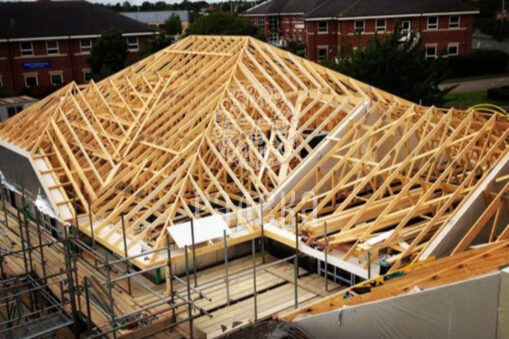
A rafter system is a set of bearing elements supporting geometry of the roof and the frame of roofing structure that gives it rigidity and a necessary slope. A composition, a section thickness and a layout of the parts of bearing roof system are determined with the help of estimation considering permanent and temporary loads.
Rafter frame performs the following functions defining functionality of the roof:
• It sets the geometry and a slope. Rafter spars give the roof a necessary slope angle and a shape that facilitates descent of snow or atmospheric precipitation from the surface. It is a frame that influences how many gables and ramps the roof will have; it is this element of the structure determines its appearance;
• It serves as a base for fixing waterproofing material. Lathing of a rafter frame is used for fixation of finishing roof covering;
• It distributes weight of the roof evenly. Interrelated components of a rafter system evenly distribute and then redirect a load from finishing covering and a weight of snow between bearing walls of the building avoiding skewing or deforming the structure;
• Provides functioning of the roof. Frame structure considering particular qualities of roof structure and a roofing material provides support, airing and protection from condensed water.
Rafters are quite complex elements requiring a careful markup and neat cutting. Mismatches in the joints of rafter spars with inferior purlin, with each other and other components of a system lead to changing slope shapes, breaking the integrity of covering and destroying nodes.
Requirements to a rafter structure
Rafter structure of the roof must correspond to important characteristics. Among these requirements one can distinguish the following:
• Rigidity. Every unit and node of rafter structure must be connected with rigid braces. Also a rigid fixation of each element must be provided;
• Lightweight. Weight of the whole structure of rafter system must be low in order not to allow heavy pressure on the walls of the building. To fit this requirement the frame is principally wooden. It can be metal only in some rare cases;
• High quality of raw materials. It’s necessary to buy wood of 1-3 sort for rafters. There must be minimal amount of knots, chips and cracks. Wood must be processed with antiseptic because it excludes the possibility of rising fungi and rot.
Classification of rafter systems
Depending on the roof structure and the purpose of attic a wooden frame can consist of rafters of several types:
Layered rafters. Rafters lean on the ridge with one edge and another edge is connected with an inferior purlin. Rafters of this type are mostly used in the simplest double or single pitch roof. Furthermore layered rafter spars form separate parts of the ramps of hipped roofs and variable mansard roofs;
Sliding rafters. They are represented as modified layered rafters. Plate joint in the upper edge and sliding support on the lower edge provide permanence of geometry of the ramp over time. Independent rafter system is a real lifeline for blockhouses that have been undergoing differential shrinkage for several years of natural drying of wood;
Suspension rafters. They are used in rafter systems of simple double pitch roof and also upper ramps of mansard. For joining rafter spars the dwangs and tie-bars are used; and the principal itself can lean on inferior purlin only and be reinforced with struts;
Sloping rafters. Because of such rafters are used for construction of ramps from the side parts of the roof they are called diagonal or angle rafters. There’s a need in sloping rafters when constructing multi-pitched roofs and geometrically complex roofs.
Rafter system from glued timbers
Elements of rafter system
Construction of rafter system of a sloping roof is performed from metal or wooden beams. Metal makes the whole roofing system heavy, gets cold and hot quickly, is more complicated during installation and requires using of professional welding equipment. Wood is principally used for private housing.
• Inferior purlin is the main component of the whole system, a kind of basement that is installed along the perimeter of the walls and creates an optimal balance of a load protecting a structure from involuntary movement during strong winds or abundant precipitation. Inferior purlin can be produced from planed timber; in some houses it can be replaced by top rail;
• Rafter spars – suspension or layered – which perform some functions:
protective – they protect the building from destroying roof or deflection under the pressure of snow pack;
basis – they constitute a frame skeleton for laying a roofing pie;
decorative – sometimes rafter spars remain open and are decorated for the interior or the exterior of the building.
• Tie-bars and hammer braces – connect rafter spars together preventing them from sliding apart;
• Pillars and struts – increase structural integrity taking a part of loads on themselves and protecting rafters from deflection;
• Sill – is a supporting beam which helps to distribute loads from pillars over a larger area;
• Dowels – planks for lengthening lower edge of rafters. They constitute a cornice of the roof protecting walls of the house from getting wet during rain and melting snow;
• Wind beam – provides additional resistance to effects of snow, wind and other loads;
• Lathing – is a beam or planks of necessary size which are fixed to rafters over waterproofing material and counter-lattice. They are located at right angle to rafter spars thereby become an extra fastening the rafters together providing more strength to the whole rafter frame;
• Ridge beam – connects upper edges of rafters, forms a straight line that outlines a roof shape.
General recommendations on the rafter system installation
Tie-bars for reinforcing rafters are produced on this principle: the closer tie-bars are to the ridge the more massive they must be. They should be produced from a wooden bar of a larger cross section and it’s necessary to control the reliability of joining nodes.
When you join rafter elements with screws it’s necessary to use metal washers – they will help to avoid keeping the nut in wood.
To avoid water drops ingestion into the walls of the house and onto the rafter system one should provide a cornice. Rafters of wood before installation should be processed with antiseptic, antifungal and fire-retarding agents for providing fire safety.
Professional installation of rafter system allows correcting some mistakes in the construction of the house. In such situations elements of a frame for roofing works are produced individually and customize scrupulously directly at the place.