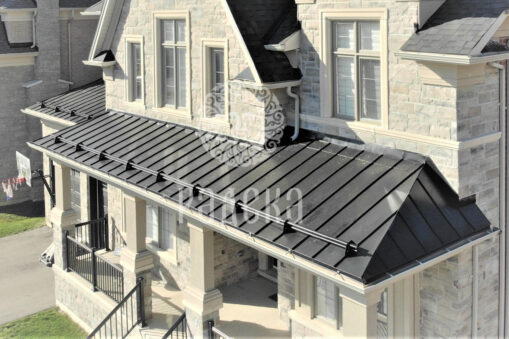
Because of climate conditions of most regions of our country where in winter there is a considerable amount of snow precipitation snow retention systems must be installed on every sloped roof.
Snow falling in windless weather gently covers the roof and in the afternoon with the sunshine and rise of temperature it’s beginning to melt. In the evening there’s an ice crust because the temperature drops. Such a surface becomes rather favorable for fixation of the following snow layers.
After the thickness of crusted snow on the roof reaches a certain amount there is a danger of its falling down. Having reached a certain critical point the snow often slides down the slope sharply like an avalanche. Sometimes it can capture a roofing material with it.
Such situation can finish tragically for a human or an animal that was accidently found under the cornice of the roof or just near it at that moment. The descent of a similar snow avalanche is able to bring significant damage to the farm – cause the need for urgent repair of roofing or seriously damage yard buildings.
Special snow retention systems of different structures were developed in order to minimize the possibility of appearing similar situations. Snow shields are destined to hold accumulated large masses of snow on the roof preventing them from sharp descent. When it’s getting warm and snow is beginning to melt, thawing water is going to leak through the gutter and lead to the storm drain.
Snow shields provide a protection from appearing icicles preventing lower edge of the roof from snow. Due to this when thawing leaking water is partially evaporated and partially freezes on metal tiling. It doesn’t accumulate in the snow therefore doesn’t form hanging icicles.
Kinds of snow retention systems
When constructing roofs the following types of snow shields are used:
• Corner snow shields. They are represented to be a bent corner shaped metal plate with painted or polymer coating. An upper facet of it forms a right angle with the flatness of the roof and is the main barrier from spontaneous descent of snow. The second facet is set at an angle to the roof that allows increasing reliability of the whole structure;
• Grid or netty snow shields. They are represented to be an ordinary grid which can be made of whole metal sheet where holes of different configurations are cut out or just welded from metal strip, round or shaped pipes;
• Tubular snow shields. They are the most common consisting of brackets and metal pipe of 15-30 mm diameter; they can be used on the roof with any slope. If an area of the roof is significant and there are large masses of snow so tubular snow shields are installed in several lines.
• Yoke snow shields. Such snow retention systems are made from single point snow jambs located on the flatness of the roof. They are used on the roofs with insignificant snow load or as an extra protection to snow shields of other types;
• Log snow retention systems. They are used quite rarely due to its massiveness; performed from rounded logs of small diameter and stacked on mounting brackets.
These types are divided into two groups: passing and barrier. Passing ones are able to gradually pass snow and thawing water through it (grids, pipes and yokes). Barrier systems don’t have such possibilities (corners and logs). The choice of the most suitable type of snow retention depends on climate conditions and also structural qualities of the roof: area, slope angle, durability of rafter system.
Snow retention systems installation
To estimate the load correctly and make a choice of a snow retention system it’s recommended to plan the choice and installation beforehand in the stage of design of the roof. Installation of snow barriers requires preliminary marking which is performed according to the design.
Installation of snow retention elements is carried out in certain areas of the roof – along the edge of the roof, on top of mansard windows, above the ventilation pipes and a chimney. It’s necessary in order to avoid damaging of these structures by ice and snow while sliding down. If the ramps are long so several lines of snow retention elements can be installed.