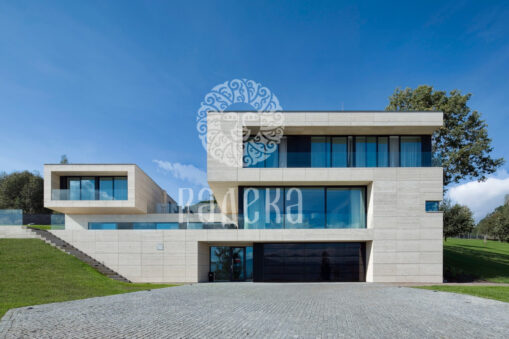
Natural travertine is a limestone rock which is a medium element between limestone and marble. Travertine is a popular natural stone which is widely used when decorating interiors and for exterior finishing works. A color scale of travertine is varied from light and almost white shades to deep brown tones.
Mainly it consists of insoluble salt calcium bicarbonate which sediments from ground waters as a result of chemical reactions. Under high pressure and temperatures the sediment is packing down and turning into a stone. Physical qualities of travertine depend on the formation conditions and can be sufficiently different according to its deposit.
Travertine consists of mineral and organic inclusions – sand, shells and plant residues. The more inclusions there are the higher the mineral’s density is and the better the operational qualities of travertine are. Its density can be defined by its color. Stone of light shades is porous and is not resistant to abrasion; it is principally used for walls finishing. The stone of deep brown shades is dense and comparable in durability with high-quality Italian marble. One can make floors, window sills and countertops from it.
Advantages of travertine
Travertine due to its qualities is a medium element between limestone and marble and has a number of important features:
• Ecological compatibility. Natural material doesn’t contain harmful impurities or toxic substances and also has no radioactive components;
• Wide scale of warm shades. Red, Tuscan walnut, classic, white, light-yellow, brown, yellow. Unlike marble travertine doesn’t look cold and brings an atmosphere of comfort to the room;
• Ease of maintenance and installation. Travertine is perfectly processed and allows finishing various surfaces;
• High durability and reliability. Travertine yields just a little to marble and granite in durability;
• Resistance to weather conditions. High-quality stone perfectly undergoes the effects of water, frost and temperature differences;
• Affordable price makes the material much more attractive for customers because it allows saving a lot of money;
• High decorative qualities. The stone looks great as a finishing material for facade and for creation interior details.
Using travertine in construction and finishing
Natural travertine is a relatively soft material which is easily subjected to different kinds of processing. Products of a high geometrical precision are made from it; for example a tile which can be laid almost without seams. Travertine has got high resistance to low temperatures so it can be applied to finishing facades.
Travertine has been used as a building stone since long ago. Bridges, amphitheaters and other buildings were constructed from it. The most famous building is the Coliseum that was constructed from roman travertine. Today one of the main spheres of using travertine is finishing facades and interior finishing of the rooms.
Travertine is successfully used in many spheres from creating sculptures or household utensils to interior and exterior finishing:
• Facing arches, columns and fireplaces;
• Stairs decoration;
• Manufacturing window sills, countertops, bar counters, shelves;
• Decoration of rooms, creating decorative panels;
• Finishing facades of buildings;
• Manufacturing sinks, shower trays, decorative mosaic, baths, facing of the swimming pools.
In Russia subway stations in Saint Petersburg are finished with travertine; among them mosques in Grozny – the mosque “Heart of Chechnya” and the mosque by name of Sakkazov Yusup Vakhaevich, also schools for Hafizes in Grozny, Urus-Martan, Gudermes and other religious places of the Republic of Chechnya. A new stadium in Krasnodar was finished with travertine for the football club Krasnodar.
Colors of travertine
It’s typical of travertine to have light colors of different shades. The stone can be white, yellowish, grayish, cream and other colors. Because of iron salts in travertine’s composition it can change a shade as a result of oxidation. For example, white stone can get a sand or yellow shade. It doesn’t influence qualities of rock. One can meet a stone of darker shades (brownish, brownish-gray and others).
Cream travertine
Yellow travertine
Classic travertine
Pink travertine
Red travertine
Brown travertine
Mixed travertine
Gray travertine
Travertine of darker color has the best technical characteristics. Also there are stones of more intensive color. Yellow and red travertine deposited in Iran can serve the example of such material. This is a calcareous tufa containing certain pigments that give it a very bright shade.
Natural travertine surface care
With proper care the travertine finish has retained its attractive appearance for years. Like all limestone rocks this stone is soft enough and rather sensitive to acid effects. So for cleaning travertine from dirt one needs to use neutral washing agents that don’t contain abrasive particles.
To increase resistance of finished surface to external influence the stone is recommended to be processed with special protective agents that close pores right after the installation. But despite all the protective measures flooring of travertine tiles will be damaged with sand and other abrasive particles over time. So it’s not recommended to use travertine for the floor in halls, lobbies and other places where people come in shoes. It’s worth using other kinds of stone for flooring in the places with intensive walking transit.
Travertine coverings are easy to restore. Scratches and small cracks appeared during operation can be grinded. But for such a work one needs to invite specialists having an experience of working with this material. During grinding specialists also can restore small holes in stone appeared after the fall of metal things. Irregularities are filled with polymer paste according to the color of the covering and then grinded. To increase wearing resistance of travertine flooring one can turn to crystallization. The process is to treat the floor with chemicals that change the structure of the top layers of the stone increasing its solidity.
Travertine quarries
In Russia deposits of travertine are located in Pyatigorsk area, in Leningrad region and in Kamchatka. There is the largest travertine quarry near Rome in Tivoli. In Germany the travertine from Canstadt has a practical importance. Pamukkale in Turkey – travertine sediments on the mountainside – is the UNESCO world heritage site. Calcareous tufas of Armenia, Azerbaijan, Kirghizia and Tajikistan are widely known.