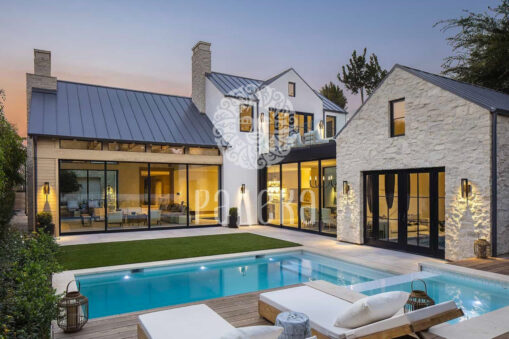
Designing the roof is a pretty complicated process requiring an executor’s professional expertise. There are quite many constructions and configurations of roofs. The choice depends on both aesthetic considerations and the conception of the building and also the presence or absence of attic, location of chimneys and an air ducts, necessity of arrangement of additional security elements – snow retention and connecting gangways.
Stages of a roof design development
The first stage of designing roofs is a choice of the form of roofing construction.
• Flat;
• Single-pitch;
• Double-pitch;
• Hipped;
• Tent;
• Mansard;
• Multi-gable;
• Multi-level.
Types of roofs in configuration
The second stage of designing roofs is a choice of a roofing material. For different roofing coverings there are certain tilt angle restrictions for slopes.
• Rolled roof — 0˚;
• Bitumen tiles — 11˚;
• Ondulin — 5˚;
• Corrugated asbestos slate — 9˚;
• Ceramic tiles — 11˚;
• Metal tiles — 14˚;
• Shaped boarding — 5˚;
• Standing seam roof — 7˚;
• Sand-cement tiles — 34˚.
During the process of designing the roofing structure it is necessary to take the ratio of the selected material to the planned tilt angle of roofing slopes into account.
The third stage of designing roofs is making a sketch where the form of the roof is refined, its size, color and final decoration is determined.
How will the building look with a selected form and kind of the roof is visually clear on the sketch. The external architecture of the building is finally agreed upon the sketch. If the draft design is agreed then one can turn to calculation of the roof structure.
Calculations of the roof structure
During the process of designing the roof it’s necessary to make two basic calculations:
1. To calculate the bearing capacity of the roofing structure. The weight of a snow load, the roofing material itself and people who sometimes will maintain and renovate the roof.
2. To calculate a rafter system – the material of a rafter system, rafters length and their section.
Based on performed calculations they draw up a common plan of the roof, its elements, nodes and details.
Calculation of the bearing capacity
During designing of the roof this index is a total loading from the snow mass pressure and the roofing covering weight. Based on the area of the roof slopes and a weight of one square meter of the covering the total mass of the roofing material is determined.
If a total area of the roof is 100 sq.m and it is covered with standing seam roofing of zinc-coated steel of 0,55 mm thick then the weight of one square meter of a folding panel of 5,15 kg is taken into account. Because folding panels are layed with an overlap and additional elements so this weight value can be surely increased up to 5,5 kg. Standing seam roofing of this brand presses on the roof structure with force of 100×5,5=550 kg.
Snow load is calculated taking into account the regional indicator that is a table indicated value. If the roof of the house is going to be provided with heat protection then it’s important to take a weight of heat protection material and vapor barrier and waterproofing membranes into account. Also pay respect to the weight of lathing – an average weight of lumber used for standard lathing of the roof is 15 kg per sq.m.
As a part of the roof design wind loads are also taken into account; they are used while calculating of the bearing capacity of the roof. They can be found in tabular or diagrammatic reference books of wind strength values by regions. The correcting coefficient that is determined according to the location of the future house must be used to calculate this indicator.
For example, if a height of the building is over 20 m and it is going to be located in open space then the correcting coefficient is 1,25. If the same building is going to be among similar buildings then the coefficient is 0,85. If a height of the building is within 10-15 m so the coefficient is 1 and 0,65, at a height of no more than 5 m the coefficient is 0,85-0,75.
Calculation of the section of rafter legs
Rafters take the main loads on themselves so we approach to the calculation of their length and section very attentively making accurate calculations. The length of rafters depends on a tilt angle of the roof and a length of a span of the building itself. Rafter system is trusses assembled as an isosceles triangle where a hip is a rafter leg.
Section of rafters is a base of bearing capacity of the roof in whole. A bearing capacity of the roofing structure is that load which must be borne by rafters. While choosing a section we also take into account the step of installing the rafters. The bigger the step is, the bigger the section of a rafter leg must be.
Typical errors while designing the roof
At first sight the design of the roof can contain insignificant errors which can cost a customer considerable additional investments when constructing the roof.
• Wrong calculations of a tilt angle of the roofing structure. Leakages and increasing of a snow load on the roof are possible that can lead to the destruction of the structure;
• Wrongly designed ventilation gap between the roofing material and the structure of the roof which extends the service life of the whole roofing system. Poorly functioning under-roof ventilation leads to rotting lumber, freezing of insulated roofs, appearance of mold and leakages inside the house;
• Wrongly designed drainage system. A special attention needs to be paid to an accurate calculation of rainwater drainage volume that depends on the area of the roof sloping and statistically average precipitation. The elements of drain must be selected of an appropriate diameter according to the precipitation volume.