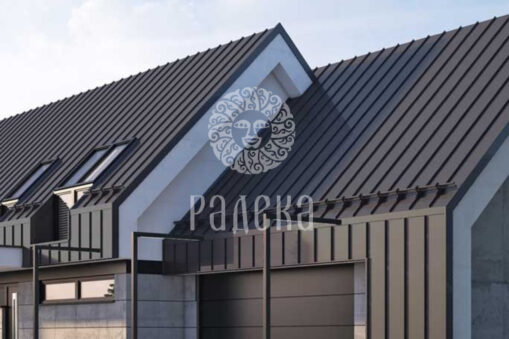
Standing seam roof is the most reliable and longevous roof covering for today. A roofing seam is a seam which helps to joint metal sheets with each other absolutely hermetically. Standing seam roof is popular when constructing and renovating the roofs of private houses and also buildings of commercial, public and religious purpose.
Advantages and disadvantages of standing seam roof
Advantages of standing seam roof:
• Impermeability. The technology of installation of standing seam roof doesn’t allow the presence of through holes in the roof covering and completely eliminates the ingress of moisture inside the structure;
• Low weight. Roof panels of 0,5-0,6 mm thick are about 5-7 kg per sq.m weight, insignificantly loading the foundation and a rafter system of the building;
• Fire safety. Standing seam roof is metal so it doesn’t burn;
• Longevity. Service period of standing seam roof is from 50 years and more.
Disadvantages of standing seam roof:
• Installation complexity. Installation of standing seam roof is not a cheap pleasure;
• Necessity of installing a roof conductor because of the ability to accumulate electric voltage;
• High resonating properties. When installing standing seam roof it’s better to do a heat protection in the inter-rafter space not on the floor of the attic.
Standing seam roof installation procedure
For installation of standing seam roof you’ll need metal sheets with folded ends – panels-pictures; folded ends serve a base for future seam. To attach metal to lathing one uses a cleat. It is attached to lathing then panels-pictures are pressed to it from both sides and pinched in lock with a special tool together with a cleat.
Installation of seam panels can be performed not only vertically but also horizontally or diagonally. The seams themselves can be grooved (the simplest and not very hermetical variant) and standing (is more hermetical because in this case a double bend is made).
Before installation of roofing panels it’s necessary to perform preparation. Firstly a drainage system, cornice and valley elements are installed and after them roofing seam panels are ready to install. Panels are installed manually or with the help of electromechanical seaming equipment. Lastly ridge and butt-end elements of the roof are installed. When installing a standing seam roof a roof pitch must have a value of not less than 3 degrees. To prevent an avalanche snowfall one should install a snow retention system. Properly installed standing seam roof will serve faithfully for more than a dozen years with a lack of any operational expenses.
Materials applied to the manufacturing of a standing seam roof
Roofing steel. It can be zinc-coated or covered with polymer. Its advantages are longevity, resistance to corrosion and affordable price. Polymer coatings have a rich color range that is also important from an aesthetic standpoint. Service period of steel roofing is not less than 50 years.
Roofing copper. There can’t be any living microorganisms and a moss among others on the copper roof. Copper is covered with patina – a layer of oxides of green color, under the influence of the environment. The major advantages of roofing copper are beauty and a long service period. The service period of a cooper roof is not less than 100 years.
Roofing aluminum. Aluminum differs in corrosion resistance, longevity, low weight – about 3 kg per sq.m, it also has many polymer coatings and a wide color range. The disadvantage of roofing aluminum is its reaction to temperature differences therefore when installing an aluminum roof they apply sliding cleats. A service period of aluminum roof is not less than 50 years.
Zinc-titanium. Zinc-titanium-copper alloy has a high level of plasticity that considerably facilitates a process of profiling metal. The disadvantage of zinc-titanium is its reaction to temperature differences therefore when installing a zinc-titanium roof they apply sliding cleats. Service period of the roof from zinc-titanium is not less than 100 years.