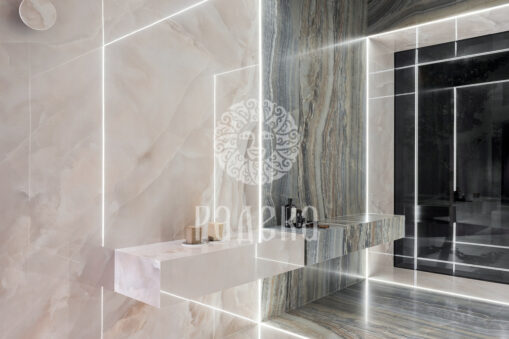
Natural stone in walls and floor cladding fills an interior with the feeling of natural, beauty and luxury. The richness of textures and a variety of natural shades of stone’s surface lets modern designers to create interiors of almost any style from traditional classic to cutting-edge directions.
Natural stone is noble, beautiful and truly practical material. It can withstand any operational loads and doesn’t lose its allure even in 20 years after installation. Thus only natural stone in walls and floor cladding is the most advantageous option from the perspective view.
Advantages of stone floors and walls cladding
• Aesthetics and beauty. Rich palette of natural stone colors – every marble or granite tile has its color and pattern. Natural tracery of veins and inclusions is never repeated;
• Permanence and usability. Floor and walls of stone cladding are not subjected to deformation; stone is resistant to abrasion and different mechanical damage during operation. High-quality natural stone cladding performed on walls and floor eliminates the possibility of scratches, cracks and chipping on its surface;
• Longevity. Stone used for cladding walls and floor is resistant to temperature differences, humidity and other weather conditions. Throughout its life natural stone doesn’t change its original appearance. The lifetime of such coverage is nearly unlimited;
• Ease of use. It’s simple enough to look after the stone tile. In order to wash off the dirt from steps and facade facing you need just wipe it with a damp cloth.
Variants of stone floor and wall cladding
Natural stone tile. Stone tiles are most often produced in such sizes: 305×305×10 mm (thickness can vary from 10 to 30 mm), 300×600×20 mm and 600×600×20 mm (thickness of such tiles can be of 20 or 30 mm). Installation of such a coating is no different from normal tiles – installation is performed through the joints and once dried they should be filled with troweling.
Large-size natural stone slabs. Slabs have approximate size of 3000×2000 mm. When installing they usually match stone patterns in order to make its veins uninterrupted giving the impression of the whole stone slab. For the floor and walls cladding they use slab of 20 mm thick but their shape and size are random and depend on the interior design.
Art panels. Due to modern technologies with numerical control pictures of stone are manufactured according to very different sizes and unusual good-looking ornaments.
Natural stone mosaic. In fact it’s a picture which can consist of a large number of various textures and colors of stone providing the unique effect to the floor or walls. The simplest example is double-colored tiles in chess order. When creating mosaic floors or walls stone is cut according to the pattern, no need in square or rectangular shape.
Kinds of stone applied for walls and floor cladding
The most widespread rocks of natural stone for floor and walls cladding indoors are granite, marble, onyx, dolomite and travertine.
Marble. Floor cladding with marble is performed in the rooms with low walking transit. Because marble is soft and porous stone, it absorbs humid and subjects to abrasion more than granite. Marble floors and walls might be the most luxurious: incomparable natural tracery of veins, polishing gloss, wealth of colors. Marble floors and walls can be polished or made from artificially aged marble – “antique”.
Granite. Floors and walls cladding with granite is performed both outdoors and indoors. Granite floors are used mainly in places with high walking transit and extreme pressures. This is due to the stone qualities – granite is two times more durable than marble, it’s a solid and dense stone which is resistant to abrasion, extreme pressures and has high level cool resistance. To prevent slipping they apply heat-treated and processed with bush hammer granite.
Onyx. Onyx is applied to floors and walls facing in luxurious interiors as it’s a semiprecious and translucent stone. It has a unique quality to transmit light; by its physical characteristics it’s similar to marble but more solid. Floors and walls are finished with onyx only in interiors.
Travertine. Walls cladding with travertine like marble and onyx is performed only in interiors. Because travertine is loose it has no resistance to abrasion.
Dolomite. Dolomite is applied for walls cladding in interior and on the facade of the building. Also dolomite might be used for manufacturing steps and window sills.
Sandstone. Sandstone tiling is a good solution for flooring in open air. A rough surface of this material naturally prevents from slipping. Sandstone is also suitable for installation of flooring in the interior.
Natural shale. Shale is suitable for interior and exterior works. A particular quality of the stone is stratification (slaty cleavage) that makes the surface of a tile textured. After finishing of floors and walls cladding the surface of shale is covered with a compound based on wax to make an effect of “wet stone” or varnished; thus beauty of the stone is getting revealed and the floor is getting protected from extra dirtying.
Limestone. Limestone is applied for floors and walls cladding in interior and exterior. Limestones are not polished so floors and walls of such slabs have nitid matte surface. The surface of limestone might be coated with wax like shale’s one.
Besides texture and color when facing walls and floor with stone one can combine various kinds of processing stone surface: matte, polished, nitid, heat treated and artificially aged of “antique” style. Using of one or another facture allows playing with color contrasts and lighting effects.